
Public sector transformation requires parliamentary reform
There I said it
There is a pretence that the delivery of public services - and the perceived failure of the state to keep up with the private sector - is the responsibility of the civil service and them alone. The ‘blob’ must be cajoled and coerced to come into the modern age. Nothing could be further than the truth.
Parliaments and their political classes are the barriers to digital public services. Parliamentary reform is required, especially at Westminster.
Constitutional reform is framed in 2 ways – electoral nerd wonkery or fringe celt-pacification.

But administrative reform is the main historical thrust of constitutional change – from the industrial bourgeoise remaking landing-owing polities or proletarians seek to remake them in their turn.
The creation of the EU and the reconstruction of post-Soviet Eastern Europe have seen fundamental administrative reform on a Napoleonic scale.
The transition between analogue and digital state requires its own.
What needs to change? Back in the 1950s a social security act had 2 parts.
A functional specification - what the system should do - collect this information, make this calculation, disburse this money.
And the powers to do the necessary non-functional or infrastructural work – how the systems should do it - buy a building, employ staff.
But the 2020s equivalent has a 2nd set of non-functional needs - sign-ons, APIs, integrations with other departments, digital powers of attorney – collectively joined-up government.
And these new non-functionals are tightly coupled to functionality.
Legislation continues to specify the functionality – but we lack a formal mechanism for making non-functional decisions for the state. The creation of these institutions is the required administrative reform.
Bold statement you say. I studied all 1,149 sections of all 76 pieces of Scottish Social Security legislation – 735 were functional specifications compared to 5 non-functional.
The state does make non-functional decisions – otherwise there would be no state computer systems. But where?
All over, service standards, departmental guidelines, blog posts, wish lists, disability legislation.
This is the problem – the functionality is a legal requirement and joining it up is only nice to have. When the inevitable delivery clashes happen, the legal requirement wins.
But even the functionality is badly done. We all agree that software programmes should be iterative. The UK government is spending £100m exploring ways of doing that. But this ignores the iteration that already exists. What are the 218 legislative instruments over 12 years in Universal Credit, or the 79 in 8 years of Scottish Social Security but iteration in action?
Legislation and ministerial orders do not have forms and processes adapted to software delivery although they are the primary mechanism for it. And change of parliamentary procedure is ultra vires of acceptable political opinion.
And the joined-up systems that have been made lack institutional form. Gov.UK Pay and Gov.UK ID are just departmental services. Common Legislative Solutions doesn’t have any recipes for digital infrastructure. They lack dedicated parliamentary oversight.
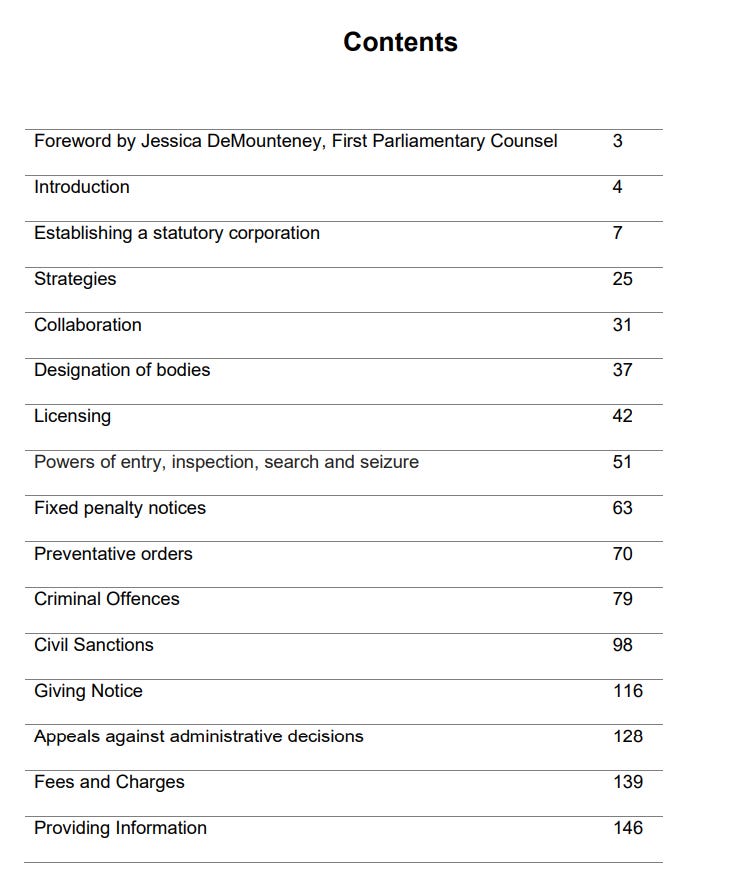
There is also an absence of recipes for data management. All systems need statements about who can write, who can read, how it is deleted, audit and what appeals processes there are. These should be written in standard language in standard structures to make data infrastructure technically and politically legible.
Bref, there is no digital transformation without administrative constitutional reform.
In Scotland, Wales and Northern Ireland the necessary elements of political constitutional reform have already been done - so this round of administrative reform is much, much easier. Not so at Westminster.
Administrative constitutional reform there will open Ernest Bevin’s Pandora’s Box of Trojan Horses with the electoral system, the Lords, the crown in parliament and executive control of it, the prerogative out and cantering about.
This is what the Foundations of the Digital State is about - you should read the Executive Summary - and if you like that, dig in deeper.
It is also why we are staging National Conversations in Scotland and Wales this May.
If you want to start the conversation about better public services you can do two things:
If we don’t put digital issues on the election agenda, nobody will, but to do that costs money - about £30 per MSP or MS. You can help us with that too:
this is pure gibberish!